



Anyone leaving Switzerland has more to do than just organize the move. You should also clarify matters related to your pension fund, tax return, and the right timing for your lump-sum withdrawal well in advance. This applies to Swiss citizens as well as to expats returning to their home country or moving on to another country. If you do not plan in advance when, where, and in what form you will receive your lump-sum benefits, mistakes or overlooked details can cost you thousands of francs. The financial consequences often cannot be reversed later.
Where can emigration planning become expensive?
Select a topic. Each card takes you directly to the related mistakes and real-life examples.
PLANNED TOO LATE?
Deadlines, buy-ins and documents
WHAT ARE YOU ALLOWED TO WITHDRAW?
EU/EFTA, third countries and the mandatory BVG portion
WHEN SHOULD YOU WITHDRAW?
Before or after leaving Switzerland?
WHERE ARE TAXES DUE?
Double-taxation agreement, destination country, canton of establishment and costs
HOW SHOULD ASSETS BE STRUCTURED?
Pension fund, vested benefits and Pillar 3a
CAPITAL, PENSION OR BOTH?
Income, flexibility and risks
Mistake no. 1: Starting to plan too late
The decisions that matter most from a tax perspective – the choice between a lump-sum withdrawal and a pension, the vested-benefits institution, the timing of the capital withdrawal, and coordination with Pillar 3a accounts – should ideally be planned months or even years in advance. Delaying action and missing deadlines substantially reduce the options for choosing when capital can be withdrawn.
Example: A person voluntarily contributes CHF 50,000 to their pension fund two years before their planned emigration and claims the amount as a tax deduction. After moving abroad, they wish to withdraw their entire pension balance. Since the three-year period has not yet expired, the tax office may retroactively revoke the deduction previously granted.

TAX TIP
Create a timeline well in advance for your move abroad, capital withdrawal, and Pillar 3a. Be sure to check the deadlines set by your pension fund and review all contributions made over the past three years.
Mistake no. 2: Not understanding the differences between EU/EFTA and Third Countries
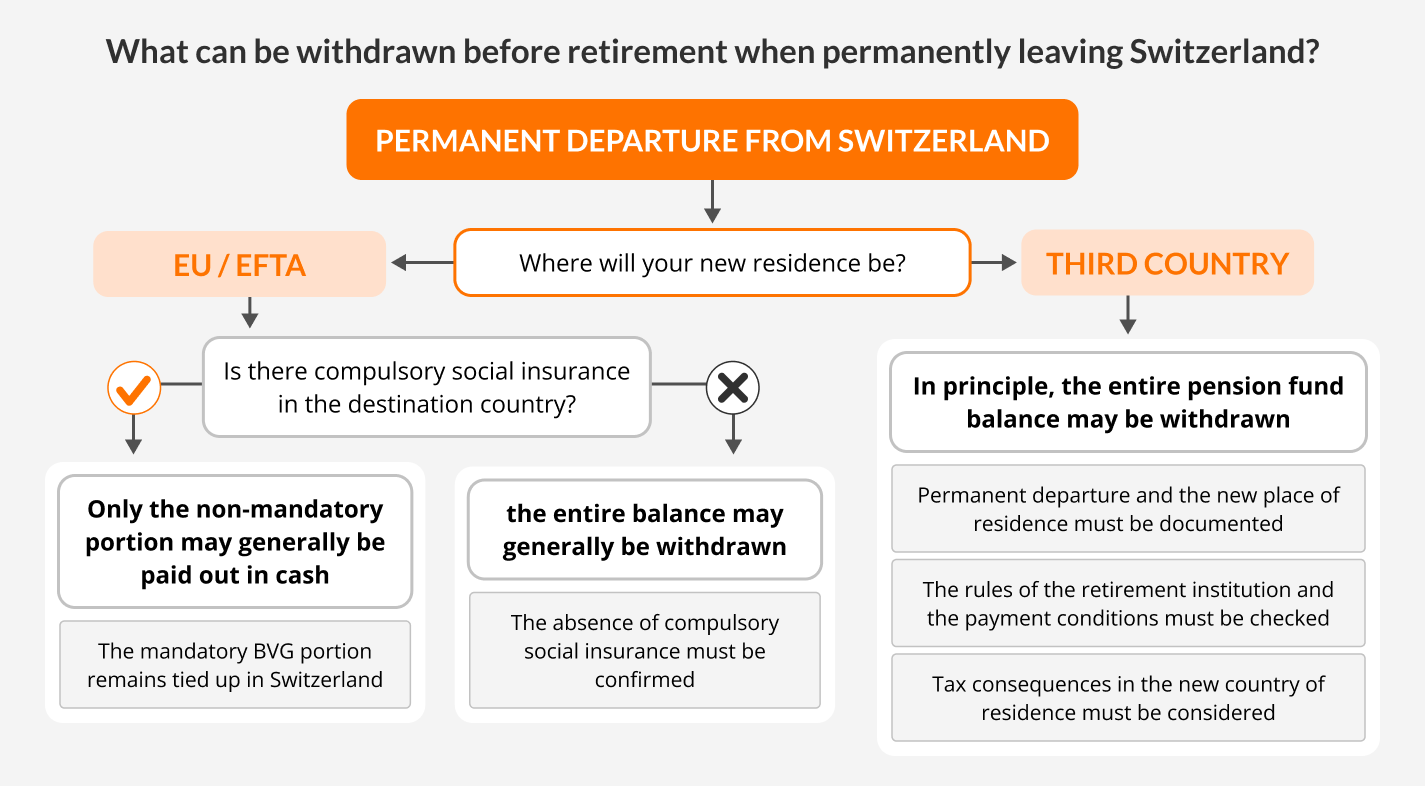
Many people mistakenly believe that they can automatically withdraw their entire pension balance in the event of permanent emigration. This may be possible when moving to a third country; however, when moving to the EU/EFTA, the mandatory portion remains tied up if the individual is subject to compulsory social insurance in the destination country. In that case, only the non-mandatory portion can be paid out in cash.
Anyone unfamiliar with this distinction might make important plans involving their capital, only to find that it is not actually available when needed. This can jeopardize a real estate purchase or one’s entire financial plan.

Note:
The mandatory BVG portion that remains tied up in Switzerland is transferred to a vested-benefits institution. It can be withdrawn later once a statutory reason for payment exists—for retirement withdrawals, generally no earlier than five years before the reference age. The obligation to be covered by social insurance in the EU/EFTA country may need to be confirmed by the relevant authority.
Practical case: Emigrating to Lithuania
A person ends their employment in Switzerland and permanently moves to Lithuania. Since Lithuania is an EU member state and has compulsory insurance for old age, death and disability, the mandatory BVG portion generally cannot be paid out in cash. It is transferred to a Swiss vested-benefits institution. The non-mandatory portion and Pillar 3a can generally be withdrawn upon permanent emigration.
The person decides to withdraw the available capital only after leaving Switzerland. The Swiss retirement institution therefore initially deducts withholding tax. The amount depends on the canton in which the paying institution is established.
At the same time, the person must determine how Lithuania treats the capital benefit. If the double-taxation agreement assigns the right to tax the specific benefit to Lithuania, they may reclaim the Swiss withholding tax under the relevant conditions. To do so, they must submit a refund application and generally prove their tax residence and, where applicable, taxation in Lithuania.
The initially more favourable Swiss withholding-tax rate may therefore become less significant: if the withholding tax is refunded in full, taxation in Lithuania ultimately determines the total tax burden.
IMPORTANT FOR THE DECISION
First clarify which portion of the retirement balance may legally be paid out. Only then should you compare the timing of the withdrawal, withholding tax and taxation in the destination country.
Mistake no. 3: Not comparing withdrawal before and after leaving Switzerland
Many people automatically withdraw their retirement capital before deregistering. Others assume that a withdrawal after departure is always more favourable. Both generalisations are wrong.
| Timing | Swiss Tax | Also check |
|---|---|---|
| Before departure | Lump-sum withdrawal tax at the place of residence | Canton, municipality and other withdrawals |
| After departure | Withholding tax at the institution’s canton of establishment | Double-taxation agreement and taxation in the destination country |
Practical case: Emigrating to the USA
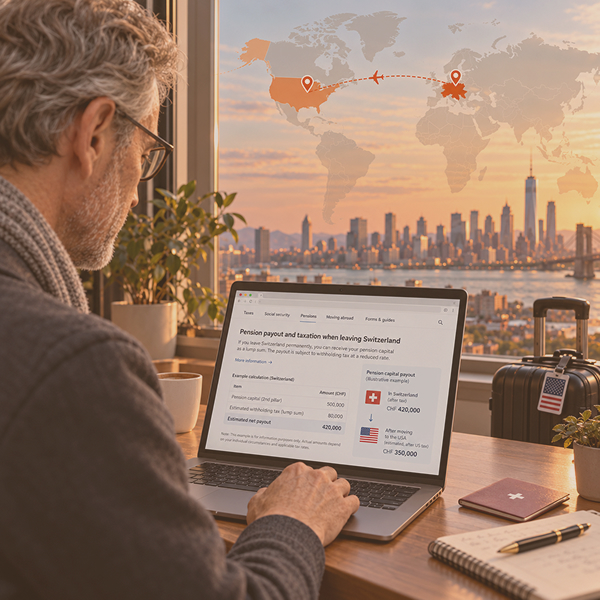
A person ends their employment in Switzerland and permanently moves to the USA. When moving to the USA, a third country, Switzerland generally permits the cash withdrawal of all retirement benefits. From a tax perspective, however, it must be clarified whether withdrawing before or after departure is more favourable.
Withdrawal before departure
If the payment is made while the person is still tax-resident in Switzerland, lump-sum withdrawal tax is due at their place of residence. The amount depends in particular on the canton and municipality of residence, the amount of retirement capital, other retirement withdrawals in the same year and, in some cases, the spouse’s withdrawals.
This option may be advantageous if Swiss lump-sum withdrawal tax is lower than later taxation in the USA. It is important that no US tax liability exists at the time of payment.
Withdrawal after departure
Once US residence has been established, the vested-benefits institution initially deducts Swiss withholding tax. For private pensions, Article 18 of the Switzerland–USA double-taxation agreement generally assigns the right to tax to the state of residence. Swiss withholding tax may then be refundable under the conditions of the agreement, while the USA taxes the benefit under its own rules.
TAX TIP
Do not compare Swiss lump-sum withdrawal tax and withholding tax alone. What matters is the net amount remaining after final taxation in both countries.
Mistake no. 4: Focusing only on Swiss taxes
As already shown when comparing the timing of a withdrawal, Swiss lump-sum withdrawal tax or withholding tax alone is not the decisive factor. A realistic assessment must take into account all financial consequences in the new country of residence.
In addition to tax on capital withdrawals and ongoing pensions, this includes other taxes, healthcare costs, exchange rates and transfer fees. Lower living costs in the destination country alone do not automatically make it the more advantageous option.

Mistake no. 5: Not checking the double-taxation agreement
The double-taxation agreement often determines whether Switzerland or the new country of residence may tax a retirement benefit. Anyone who does not review the agreement risks unnecessary double taxation and forfeiting a potential refund.
If the agreement assigns the right to tax to the country of residence, Swiss withholding tax is often nevertheless deducted initially and must subsequently be reclaimed. The refund is not automatic. You must submit the application and the required documents.

Mistake no. 6: Choosing a vested-benefits institution based on the tax rate alone
TAX TIP
Have fees and payment terms confirmed in writing. The decisive figure is how much remains after taxes, costs and possible investment losses.
Practical case: Moving to the United Kingdom - does switching to Schwyz pay off?
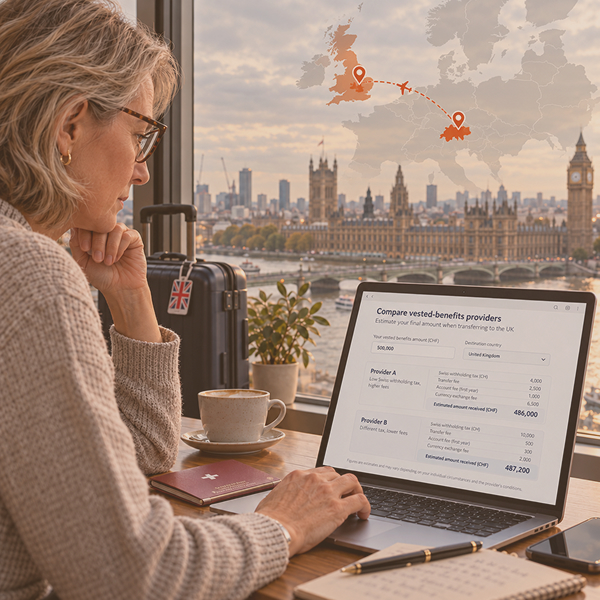
A 50-year-old employee plans to emigrate to the United Kingdom a few months after their employment ends. Their pension fund balance of approximately CHF 114,000 is first to be transferred to a vested-benefits institution and then paid out because of their permanent departure.
The existing vested-benefits foundation is not legally established in the tax-favourable canton of Schwyz. It is therefore considered whether a prior transfer to a Schwyz-based vested-benefits foundation would be worthwhile. The calculation shows a potential withholding tax saving of several thousand francs. However, this must not be viewed in isolation: some providers charge substantial fees for a short-term transfer followed by a payment. This can eliminate a large part of the tax advantage.
The double-taxation agreement with the United Kingdom must also be taken into account. If the person is already resident in the United Kingdom when payment is made, Swiss withholding tax may be final depending on the applicable treaty provision. The timing of the withdrawal and tax residence must therefore be assessed together.
IMPORTANT FOR THE DECISION
Do not compare withholding tax rates alone. The decisive figure is the net amount after withholding tax, transfer and payment fees, and any taxation in the destination country. Have all costs and conditions confirmed in writing before making a change.
Mistake no. 7: Withdrawing pension fund and Pillar 3a assets without coordination
In Switzerland, lump-sum payments from pension funds, vested benefits, and Pillar 3a are taxed separately from other income and at a lower tax rate. However, many people make the mistake of withdrawing multiple pension assets in the same calendar year. For tax rate purposes, however, these withdrawals are aggregated, which can increase your total tax liability. This may also apply to your spouse’s pension withdrawals.
To avoid unnecessarily high tax progression, you can spread multiple pension withdrawals – provided it is feasible in terms of timing and legal requirements – over several years. If you move abroad, you’ll also need to check the tax rules in your destination country.

Mistake no. 8: Splitting vested benefits incorrectly
Upon leaving an employer, pension fund assets may be distributed among no more than two vested benefits institutions. This allows for different investment strategies and withdrawal timelines.
When making your selection, you should consider not only withholding tax but also fees, potential returns, investment risks, the payout date, and beneficiary designations in the event of death. An interest-bearing account offers more stability, while securities promise higher potential returns but also carry the risk of loss. A high proportion of stocks can be particularly risky shortly before the payout.
Which solution is more suitable for you depends primarily on your personal risk tolerance and your planned withdrawal date. If you’ll need the capital soon, you should prioritize security and liquidity. For a longer investment horizon, a securities-based solution might make sense, provided that temporary losses are financially manageable.

Mistake no. 9: Choosing capital or a pension without a calculation
Anyone who looks only at tax, immediate availability or the amount of the pension may make a decision with permanently adverse consequences. Possible outcomes include insufficient income in old age, capital that is depleted too quickly, or inadequate protection for surviving dependants.
The following overview shows the key advantages and disadvantages of both withdrawal options:
| Criterion | Lifetime pension | Lump-up withdrawal |
|---|---|---|
 Income |
Regular and lifelong | Must be planned independently |
 Flexibility |
Low; capital is not freely available | High; capital can be used freely |
 Investment and risk |
No personal investment decision required | You bear investment and loss risks |
 Inheritance |
Only benefits provided for in the regulations | Remaining assets are generally inheritable |
 Major expenses |
Only limited financing possible | Capital immediately available |
 Taxes abroad |
Check ongoing taxation of the pension | Check taxation upon withdrawal and thereafter |
 Particularly suitable |
When security is the priority | When flexibility is possible and financial risks are manageable |

WHAT ABOUT A COMBINATION?
A combination can make sense: the pension covers regular basic costs, while part of the capital remains available for reserves, larger expenses or inheritance. The appropriate split depends on your budget, assets, family, health and country of residence.
Mistake no. 10: Underestimating the documentation and deadlines
Missing documents can delay the payment or a tax refund. The required documents depend on the specific pension fund, marital status, destination country and reason for payment. In general, deregistration confirmation and new proof of residence, identity and civil-status documents, the spouse’s consent, and evidence of social insurance are required. Additional supporting documents are required for a tax refund.
There is no standard processing time. If all documents are complete, some institutions can make payment within a few weeks.

FAQ about pension fund and emigration
What happens to my Swiss tax return when I move abroad?
When you leave Switzerland permanently, your Swiss tax situation must be settled up to the date of your departure. Depending on your circumstances, pension withdrawals, outstanding income, assets and other tax matters may need to be included or coordinated. The tax treatment also depends on your new country of residence.
If you are planning your move, it is therefore important to prepare your final Swiss tax return correctly and on time. For professional support with your Swiss tax return, see our tax return services for private individuals.
Can I withdraw my entire pension fund if I move to an EU or EFTA country?
Not necessarily. If you move to an EU/EFTA country and are subject to compulsory social insurance there, the mandatory BVG portion generally cannot be paid out in cash. It must remain in Switzerland, usually with a vested-benefits institution. The non-mandatory portion may generally be withdrawn. The exact situation should be checked before you leave Switzerland.
Is it better to withdraw my pension fund before or after emigrating?
There is no universally better option. If you withdraw before leaving Switzerland, the lump-sum withdrawal tax is generally based on your place of residence in Switzerland. If you withdraw after establishing residence abroad, Swiss withholding tax is generally deducted by the pension or vested-benefits institution. The applicable double-taxation agreement and taxation in your new country of residence can then become decisive.
Can I choose a vested-benefits institution in a canton with lower withholding tax?
In principle, the canton in which the paying institution is established can affect the Swiss withholding tax on a payment made after emigration. However, choosing an institution solely because of its cantonal tax rate is not necessarily advantageous. Transfer fees, payment costs, currency conversion costs and the tax treatment in your new country of residence should also be considered.
What happens to my pension fund if I move to the USA?
The USA is a third country, so a person permanently emigrating there can generally withdraw the full pension fund balance, subject to the applicable conditions. However, the timing of the withdrawal is important. A withdrawal before departure may be subject to Swiss lump-sum withdrawal tax, while a withdrawal after establishing US residence may involve Swiss withholding tax and US taxation. The Switzerland–USA double-taxation agreement should therefore be reviewed before deciding when to withdraw.
Can I withdraw my pension fund and Pillar 3a in the same year?
Yes, if the legal requirements for both withdrawals are met. However, lump-sum withdrawals from pension funds, vested benefits and Pillar 3a are generally taken into account together for determining the applicable tax rate. Making several withdrawals in the same calendar year can therefore increase the tax burden. Where legally and practically possible, spreading withdrawals over different years may reduce tax progression.
Do you need support?
Our tax team helps you coordinate the withdrawal of your pension fund assets, your final Swiss tax return and the tax consequences in the destination country in good time. If you would like to have your tax return prepared professionally, we will be happy to advise you – on tax returns in Zurich as well as in other German-speaking cantons. Further information can be found on our website.

mit praktischen Tipps
und Beispielen für Ihre
private Steuererklärung
Zum Gratis Download

Leave Comment